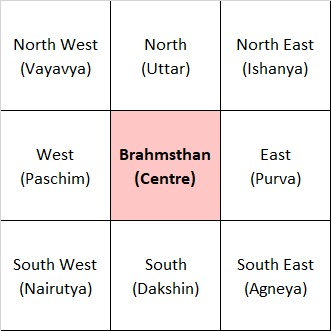
Brahmasthan (Centre)
ब्रह्मस्थान
Brahmasthan, or the central zone of a house or plot, is associated with Lord Brahma and the Space element (Akasha Tattva). It represents creation, balance, harmony and interconnectedness, making it the most important area to preserve as open, light, clean and unobstructed in a building.
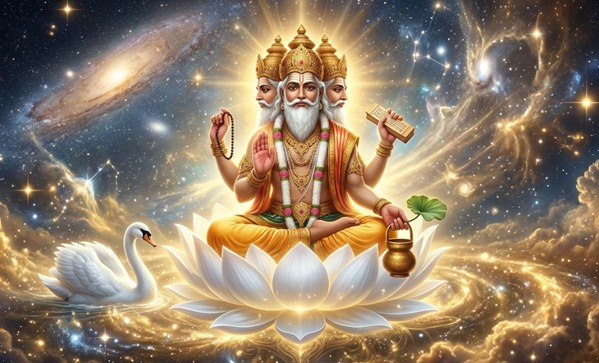
The word "Brahmasthan" (ब्रह्मस्थान) is derived from two Sanskrit words: "Brahma," referring to Lord Brahma, the creator of the universe, and "Sthana," meaning place or position. Therefore, Brahmasthan literally translates to the "Place of Brahma" or the "Abode of the Creator."
In Vastu Shastra, Brahmasthan occupies the central portion of the Vastu Purusha Mandala and is regarded as the central and most significant zone of a building or plot. It represents creation, balance, harmony and the integration of all directional energies. Traditionally, this area is expected to remain relatively open, uncluttered and free from excessive structural obstructions.
This direction is also called the Urddhva Disha (i.e. Zenith / Upward Direction). It is a cosmic orientation that inspires human beings to transcend their limitations and align with the infinite expanses of universal consciousness.
Planet
Brahmasthan is associated with no single planetary ruler. It is traditionally governed by Lord Brahma, who represents creation, knowledge and the cosmic order.
Element
Space element (Akasha Tattva) is associated with the Brahmasthan. Space represents openness, expansion, interconnectedness and the medium through which the other four elements exist and interact.
As the central zone of the Vastu Purusha Mandala, Brahmasthan symbolises the integration of the five elements and the balance of the surrounding directions. It is therefore traditionally recommended to remain open, light and unobstructed.
Best: What Should Be Placed Here
Open Space: Keeping the Brahmasthan open is one of the most widely followed principles of Vastu Shastra. Traditional architecture often incorporated a central courtyard that facilitated natural light, ventilation and interaction between different parts of the building.
Light and Natural Illumination: The centre should ideally receive adequate natural light. Skylights or other architectural arrangements can be considered to create a bright and pleasant central area.
Movement and Circulation: The Brahmasthan should ideally facilitate convenient movement between different parts of the property. It should not become an area that obstructs circulation or creates congestion.
Minimal and Light Furnishing: If the centre forms part of a living space, minimal furniture and light furnishings can be considered. The objective is to preserve a sense of openness rather than create a heavily occupied zone.
Avoid: What Not to Do Here
Toilets and Bathrooms: Toilets are traditionally considered unsuitable in the Brahmasthan. Since this is the central zone of the Vastu Purusha Mandala, it is generally recommended to keep it free from such functional obstructions.
Heavy Staircases: Avoid placing heavy staircases or substantial structural masses in the centre wherever the architectural design permits. These can occupy a significant portion of the central space and restrict movement.
Heavy Storage: Avoid large cupboards, storage rooms, bulky furniture and unnecessary accumulation of heavy objects in this zone. The Brahmasthan is traditionally preferred to remain light and open.
Kitchen and Fire Installations: A kitchen, cooking stove or major fire-related installation is generally not preferred in the Brahmasthan. The South-East is traditionally considered more suitable for activities associated with Agni Tattva.
Columns and Structural Obstructions: Avoid unnecessary structural obstructions in the central area. However, structural columns and load-bearing elements should never be removed or altered merely to comply with Vastu recommendations. Structural safety must always take priority.
Clutter and Waste Materials: Avoid using the centre as a dumping area for unused articles, waste materials or miscellaneous household items. Keeping it clean and organised helps preserve its traditional character.