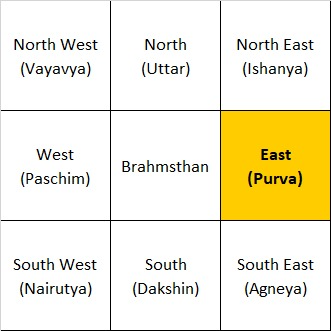
Purva Disha (East)
पूर्व दिशा
Purva Disha, or the East direction, is associated with Indra Dev and the rising Sun. It represents vitality, illumination, authority and new beginnings, making it a preferred zone for entrances, living spaces, study areas and openings that welcome natural morning sunlight.

The word "Purva" (पूर्व) in Sanskrit means east or the direction from which the Sun rises. In Vedic tradition, the East is associated with Indra, the king of the Devas and the guardian deity of this direction. Indra represents power, authority, leadership, courage and prosperity. Since the East receives the first rays of the rising Sun, this direction is also associated with new beginnings, vitality, enlightenment and growth. It is considered an important direction for bringing natural light and positive activity into a house or building.
Planet
East is governed by the planet Sun (Surya). Surya represents vitality, confidence, authority, leadership, health and recognition. Just as the Sun illuminates the world and sustains life, the eastern direction is associated with illumination, growth and the beginning of new activities.
Element
The East is associated with solar energy, light and vitality in Vastu practice. This direction is an amalgamation of Water and Fire energies. While the North-East, South-East, South-West and North-West are commonly associated with the four elements of Water, Fire, Earth and Air respectively, the East is particularly connected with the rising Sun and its life-sustaining energy. Sunlight represents illumination, awareness, warmth and the nourishment of life.
Best: What Should Be Placed Here
Main Entrance: The East is traditionally considered an auspicious direction for the main entrance. An entrance in a suitable eastern pada can facilitate natural light and create a welcoming entry to the property. However, its suitability should be assessed in relation to the exact entrance position and the overall layout.
Living Room: The East is suitable for a living room or common family space, where occupants can benefit from natural morning light and an open, welcoming environment.
Windows and Openings: Windows, balconies and other openings can be provided in this direction to allow morning sunlight and natural ventilation. The size and placement should also consider climate, privacy and building design.
Study Room: A study or learning space can be considered in the East. Its association with illumination, awareness and knowledge makes it a suitable location for reading, studying and intellectual activities.
Open Spaces: Keeping the eastern side relatively open, clean and unobstructed is a commonly followed Vastu principle. It allows better access to natural light and contributes to a bright and pleasant environment.
Avoid: What Not to Do Here
Toilets: Toilets are generally not preferred in the East, particularly in its more sensitive padas. Their suitability should be evaluated in the context of the complete layout rather than assuming any particular health or financial consequence.
Heavy Storage: Avoid excessive heavy construction, bulky cupboards and large storage units along the eastern side. Traditionally, this direction is preferred to remain relatively light and open.
High Walls and Obstructions: Avoid unnecessarily high compound walls, large structures or other obstructions that prevent morning sunlight from entering the property. Adequate privacy and security should, however, be maintained.
Excessive Clutter: Avoid accumulating unused articles, waste materials or unnecessary objects in this direction. Keeping the East clean and organised supports its traditional association with light and freshness.
Kitchen: The East is not generally the first preference for a kitchen, as the South-East is traditionally associated with Agni Tattva and cooking activities. However, an eastern kitchen should be assessed based on its exact location and functional arrangement.