Gand Mool Nakshatra
गण्डमूल नक्षत्र
Gand Mool Nakshatras are six specific constellations in Vedic astrology positioned at the sensitive junction points between water and fire signs. While birth or major activities like property purchases in these stars can create energetic instability, simple traditional remedies and careful Muhurat selection help ensure harmony and stability.
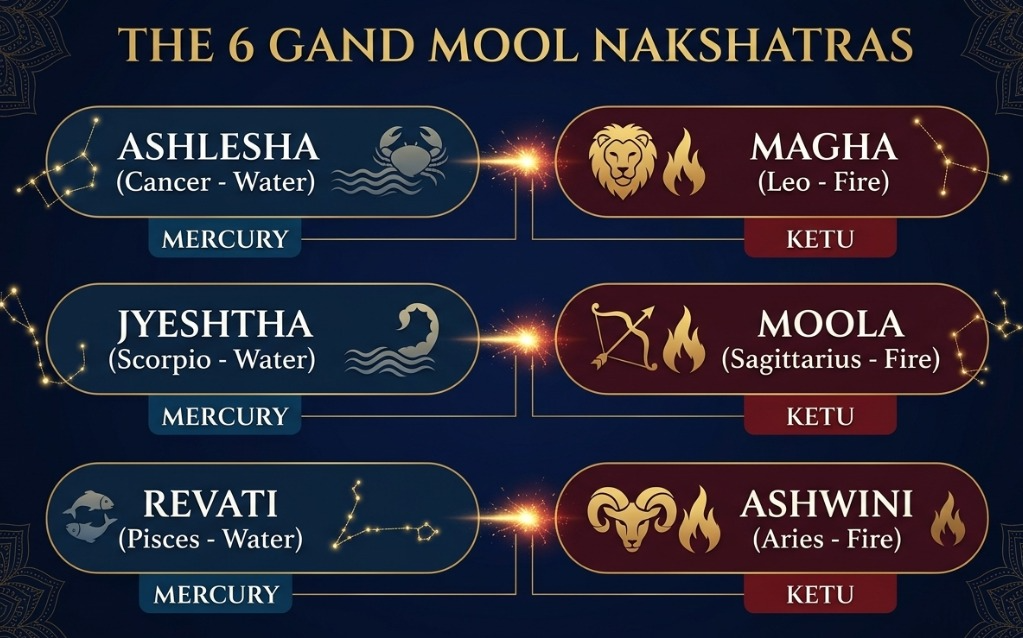
Gand Mool Nakshatras are a group of six nakshatras in Vedic astrology that occupy sensitive junction points where a Jal Tatva Rashi (Water Element Zodiac) ends and an Agni Tatva Rashi (Fire Element Zodiac) begins.
All six of these Nakshatras are ruled by either Mercury or Ketu, and a birth when the Moon is in one of them creates Gand Mool Dosha.
Nakshatra | Planet | Rashi | Most sensitive pada |
Ashwini | Ketu | Aries (Agni) | 1st Pada |
Ashlesha | Mercury | Cancer (Jal) | 4th Pada |
Magha | Ketu | Leo (Agni) | 1st Pada |
Jyeshtha | Mercury | Scorpio (Jal) | 4th Pada |
Moola | Ketu | Sagittarius (Agni) | 1st Pada |
Revati | Mercury | Pisces (Jal) | 4th Pada |
What does it mean:
Traditional Impact: A child born under Gand Mool is traditionally believed to bring early-life health challenges, financial fluctuations, or relationship strain for themselves or close family members like parents and siblings.
Modern Perspective: However, Gand Mool birth is not a fixed misfortune. The overall strength of the birth chart matters far more, and many prominent leaders and successful individuals were born in these Nakshatras.
Common Remedies
Gand Mool Shanti Puja: Families traditionally perform a Mool Shanti peace ritual on the 27th day after birth, when the Moon returns to the exact same Nakshatra.
Mantra & Worship: Chanting mantras for Mercury or Ketu (depending on the Nakshatra) and offering prayers to Lord Ganesha or Lord Vishnu are standard remedies.
Charity: Donating food, clothes, or essentials on days when the Moon transits the birth Nakshatra is also recommended.
Impact of Each Gand Mool Nakshatra on Property related activities
Nakshatra | Property Buying & Registration | Bhoomi Pujan & Construction | Reasoning |
Ashwini | Neutral / Conditional | Avoid | Swift (Kshipra) nakshatra good for quick transactions or commercial flips, but poor for Bhoomi Pujan because it lacks permanence |
Ashlesha | Avoid | Strictly Avoid | Sharp (Tikshna) nakshatra associated with entanglement. Property bought or started here risks legal disputes, hidden structural flaws, or family discord |
Magha | Conditional | Avoid | Fierce (Ugra) nakshatra ruled by Ketu and Pitra. Some calendars allow registration if it suits the buyer's birth chart, while others advise caution for new constructions |
Jyeshtha | Avoid | Strictly Avoid | Sharp (Tikshna) nakshatra. Starting construction or registering land here is linked to delays, financial strain, and loss of harmony |
Moola | Mixed / Cautious | Avoid | Ruled by Nirriti (dissolution). While some modern lists include it for property registration, traditional Vastu avoids it for digging or foundation work as it can uproot stability |
Revati | Highly Auspicious | Favorable | Soft (Mridu) nakshatra ruled by Pushan (nourishment). It brings smooth paperwork, peaceful living, and long-term prosperity. (Note: Avoid the very end of the 4th Pada, which overlaps with Panchak and Gandanta) |
Being born in a Gand Mool Nakshatra does not stop you from buying property.