Mahendra Devta
महेन्द्र
Mahendra Devta (Lord Indra), the devta of supreme leadership, power, and administrative networking rides his divine white elephant, Airavata, holding a glowing thunderbolt (Vajra). He is bathed in a brilliant blend of royal golden light and deep blue celestial hues, symbolizing supreme authority, social connectivity, and the commanding power to rule over circumstances with foresight and nobility.
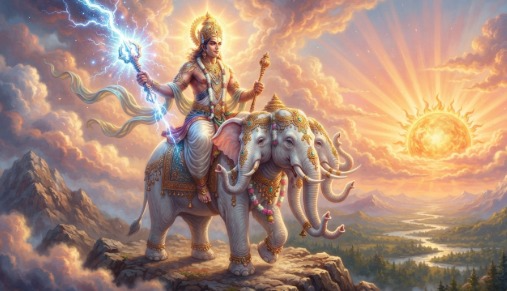
Mahendra is the Vedic Devta associated with leadership, administration, high social status, and the vast power of networking. Representing Lord Indra in his full kingly glory, this energy field controls executive authority and commands respect in society.
Pada in Vastu Purush Mandal
Mahendra resides as the fourth energy field (pada) in the Purva disha, positioned right along the outer perimeter. He sits directly next to Jayant (the 3rd pada) and serves as the bridge toward Surya (the 5th pada).
What does this Pada do
Mahendra bestows the power of association, enabling individuals to connect deeply with influential people, maintain high administrative control, and build an expansive, supportive social circle.
Probable Signs of an Imbalance
If this Pada is blocked or disturbed by heavy structures, clutter, or toilets, the following issues often manifest in the household:
Isolation: Family members struggle to establish a presence in society or maintain a reliable network of supportive friends and associates.
Loss of Authority: An executive or business leader living in the space may face a sudden decline in their respect, leadership power, or management capability.
Balancing and Optimization
To maintain a healthy flow of Mahendra's authoritative energy, the East-perimeter zone must be carefully managed:
Keep it Majestic and Elegant: Keep this specific area well-organized and aesthetically neat to mirror a space of respect and command.
Avoid Devaluing Elements: Keep household waste bins, heavy dark storage, or toilets away from this zone, as they taint social networking and status.
Enhance Social Vibrations: Decorate with shades of green or light wood elements, allowing sufficient ventilation to attract vibrant growth and administrative success.
Naam Mantra
ॐ भूर्भुवः स्वः महेन्द्राय नमः॥
Naivedya (Offerings)
Kheer (खीर), Honey (मधु) and Fresh Fruits (फल)
Modern Vastu Pada and Degrees
E4
Angular Degree from Centre - 78.75° to 90.0° (Absolute East is 90°)