Dikpal
दिक्पाल
Dikpalas are the traditional guardians of the eight directions. Each devta represents a distinct aspect and their charactics shape the activities and remedies of that direction
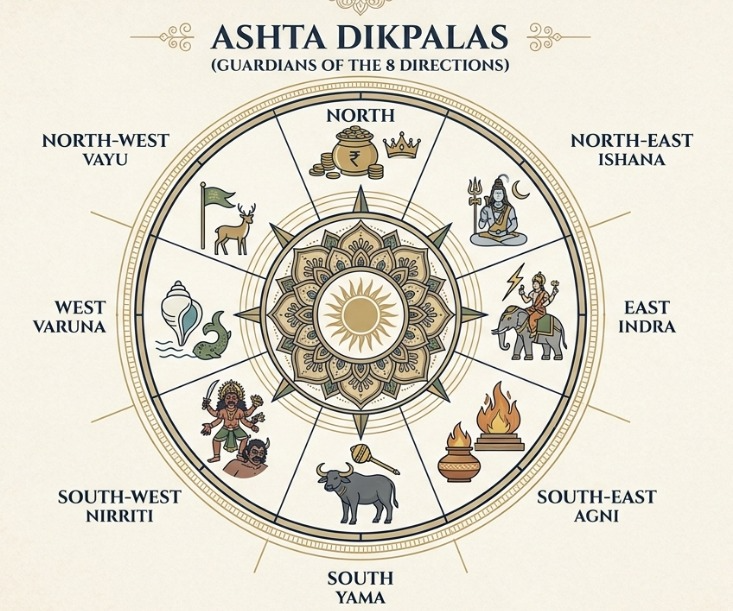
In Vastu Shastra, the universe is understood not merely as a physical space but as an organised system in which every direction has its own significance. The cardinal directions are North, East, West and South while the inter-cardinal directions are North-East, South-East, South-West and North-West. Each of the eight principal directions is associated with a presiding devta known as a Dikpala or Digpala.
The Sanskrit word Dikpala is formed from two words: Dik, meaning direction, and Pala, meaning protector or guardian. Thus, Dikpalas are the guardians or protectors of the directions.
These deities are an important part of Hindu cosmology, temple architecture and Vastu Shastra. Their presence establishes a sacred understanding of space, where each direction represents a distinct aspect of cosmic order and natural functioning.
The Concept of Ashta Dikpalas
The eight principal directional guardians are collectively known as the Ashta Dikpalas. Each presides over one of the eight directions—East, South-East, South, South-West, West, North-West, North and North-East.
Direction | Dikpala | Features |
|---|---|---|
(East) | Indra | Authority, power, leadership and protection |
(South-East) | Agni | Fire, energy, transformation and vitality |
(South) | Yama | Discipline, justice, order and restraint |
(South-West) | Nirriti | Dissolution, decay and protection against destructive forces |
(West) | Varun | Order, water, moral law and accountability |
(North-West) | Vayu | Movement, breath, communication and change |
(North) | Kuber | Wealth, resources, prosperity and abundance |
(North-East) | Ishana (Shiva) | Spirituality, divine consciousness and higher knowledge |
Dikpalas and Vastu Purusha Mandala
The concept of Dikpalas is closely connected with the understanding of the eight directions in the Vastu Purush Mandal.
This directional arrangement helps explain why different zones are traditionally assigned different qualities and functions in Vastu. Each Dikpala has a unique quality on the basis of which functions and activities are assigned to the particular direction. Very often, remedies too are applied on the basis of dosha as per the dikpala.
Ashta-Dikpalas and Dasha-Dikpalas
While the Ashta Dikpalas represent the guardians of the eight principal horizontal directions, there are two additional directions unique to Vedic Vastu Shastra. The fusion of Hindu science and traditions consequently describe ten directional guardians, known as the Dasha-Dikpalas.
The two additional directions are:
Urdhva Disha (Above): Lord Brahma is associated with the upward direction or the celestial dimension.
Adho Disha (Below): Lord Ananta or Shesha is associated with the downward direction or the subterranean dimension.
The inclusion of these two directions expands the concept from the eight horizontal directions to a ten-directional framework.
Importance of Dikpalas in Vastu
The Dikpalas provide a traditional framework for understanding the qualities attributed to different directions. They help explain why certain activities and spatial functions are associated with particular zones.
The Dikpalas offer the philosophical and symbolic foundation for understanding directions. Their significance becomes more meaningful when studied alongside classical Vastu principles and architectural requirements.