Savita Devta
सविता
Representing the divine stimulating power of the rising Sun (Savitur—the inspirer of intellect and action), this vital inner energy field directly regulates spark of initiative, financial momentum, mental alertness, and the activation of plans within the household
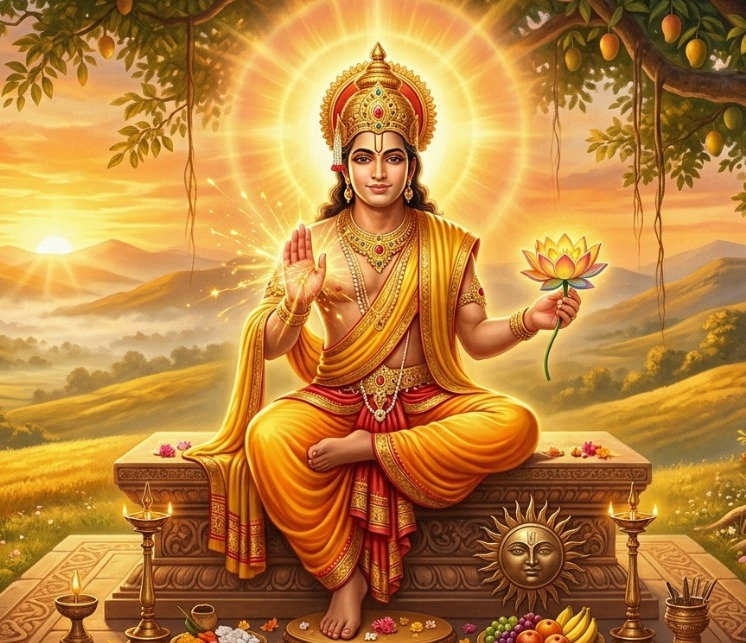
Savita (traditionally revered as the solar Aditya invoked in the sacred Gayatri Mantra who awakens consciousness and sets creation into motion) is the Vedic devta associated with inspiration, decisive energy, resource generation, and dynamic execution. Positioned immediately South-East of the central Brahmasthan, this energy field ignites the motivation needed to turn stagnant ideas into thriving ventures.
Pada in Vastu Purush Mandal
Savita resides in the inner ring (Antahpada) at the Agneya Kon vertex of the central Brahmasthan. In a 9×9 (81-pada) Vastu Purush Mandal, he occupies the inner South-East diagonal pada directly bordering Brahma, paired closely with Savitr (who sits immediately adjacent to him toward the outer Agneya Kon), and flanked by Aryama to the Uttar disha and Vivasvan to the Pashchim disha.
What does this Pada do
Savita provides the stimulating, energizing fire required to initiate new projects, maintain healthy cash flow momentum, sharpen intellectual focus, and infuse the household with enthusiasm and drive.
Probable Signs of an Imbalance
If this inner Pada is blocked or disturbed by heavy water elements, toilets, clutter, or dark underground pits, the following issues often manifest in the household:
Procrastination and Stalled Initiatives: Family members experience chronic lethargy, hesitation, and an inability to launch planned ventures or complete tasks on time.
Cash Flow Bottlenecks: Occupants face sudden blockages in liquid funds, delayed payments, and a lack of energetic momentum in business or career.
Balancing and Optimization
To maintain a bright, invigorating flow of Savita's stimulating energy, this crucial inner South-East zone must be carefully managed:
Keep the Inner South-East Clean and Vibrant: As an inner pada bordering the Brahmasthan, keep this area uncluttered, well-lit, and free of heavy water storage.
Strict Prohibition of Water Features and Toilets: Never construct underground water tanks, fountains, or toilets in this inner South-East zone, as water extinguishes the activating solar fire of Savita.
Enhance with Warm Solar and Agni Hues: Decorate this space using clean off-white, soft cream, warm pastel peach, or subtle golden-saffron accents, ensuring strong illumination.
Naam Mantra
ॐ भूर्भुवः स्वः सवित्रे नमः॥
Naivedya (Offerings)
Sweetened wheat pudding or Halwa (हलवा), Jaggery with roasted sesame (तिल-गुड़) and Pure cow ghee sweets (शुद्ध घृत मिष्ठान)
Modern Vastu Pada and Degrees
Inner South-East Zone (Antahpada – South-East of Brahmasthan)
Angular Degree from Centre: 112.5° to 157.5° (centered along the 135.0° South-East diagonal in the inner ring)