Vivasvan Devta
विवस्वान्
Representing the blazing midday Sun and the supreme cosmic force of transformation, this vital inner energy field directly regulates fame, authoritative leadership, digestive and metabolic fire, and the successful culmination of efforts within the household.
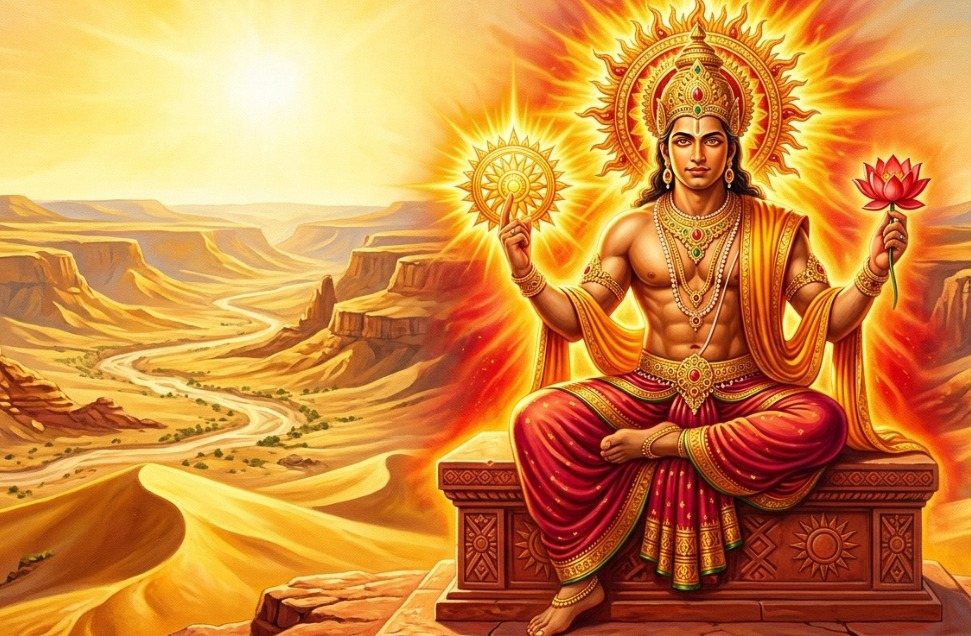
Vivasvan (traditionally revered as the radiant solar progenitor of Manu and the personification of peak solar brilliance) is the Vedic devta associated with change, peak visibility, disciplined action, and authoritative recognition. Positioned immediately South of the central Brahmasthan, this energy field acts as the transformative engine that turns consistent effort into high public standing and decisive outcomes.
Pada in Vastu Purush Mandala
Vivasvan resides in the inner ring (Antahpada) directly bordering the central Brahmasthan on the Dakshin disha. In a 9×9 (81-pada) Vastu Purush Mandal, he occupies the three central padas immediately South of Brahma, flanked by Savita / Savitra toward the Agneya Kon and Indra / Indrajay toward the Nairitya Kon, while bordering Grihakshat (S4), Yama (S5), and Gandharva (S6) on his outer edge. He is the inner devta in Dakshin disha.
What does this Pada do
Vivasvan provides the transformative solar energy required to achieve recognition in one's field, embrace positive life changes, build unshakeable self-confidence, and exercise righteous authority without arrogance.
Probable Signs of an Imbalance
If this inner Pada is blocked or disturbed by heavy water elements, toilets, clutter, or dark underground pits, the following issues often manifest in the household:
Lack of Recognition and Stagnation: Family members work tirelessly behind the scenes yet receive zero credit, struggling to gain promotions or public visibility.
Fear of Change and Low Vitality: Occupants resist necessary life transitions, feel chronically fatigued, and suffer from weak willpower or sluggishness.
Balancing and Optimization
To maintain a steady, empowering flow of Vivasvan's transformative energy, this crucial Southern inner zone must be carefully managed:
Keep the Inner South Clean and Grounded: As an inner pada adjacent to the Brahmasthan, keep this area uncluttered, dignified, and well-proportioned without heavy overhead water tanks or subterranean pits.
Strict Prohibition of Water Features and Toilets: Never construct underground water tanks, fountains, or toilets in this inner Southern zone, as water extinguishes the peak solar fire of Vivasvan.
Enhance with Warm Solar and Earth Hues: Decorate this space using clean off-white, warm beige, soft terracotta, or subtle golden-amber accents, maintaining bright, uplifting illumination.
Naam Mantra
ॐ भूर्भुवः स्वः विवस्वते नमः॥
Naivedya (Offerings)
Sweetened wheat porridge or Dalia (मीठा दलिया), Jaggery with pure ghee (गुड़-घृत) and Red or golden fruits (लाल एवं पीले फल)
Modern Vastu Pada and Degrees
Inner South Zone (Antahpada – South of Brahmasthan)
Angular Degree from Centre: 135.0° to 225.0° (centered along the 180.0° South axis in the inner ring)