Uttara Ashadha Nakshatra
उत्तराषाढ़ा नक्षत्र
Uttara Ashadha is the twenty-first Nakshatra in Vedic astrology, symbolized by the elephant's tusk and ruled by the Sun and Vishvadevas. Discover its core astrological features, symbol, four padas, and high suitability for real estate purchases, Bhoomi Pujan, construction, and Griha Pravesh.
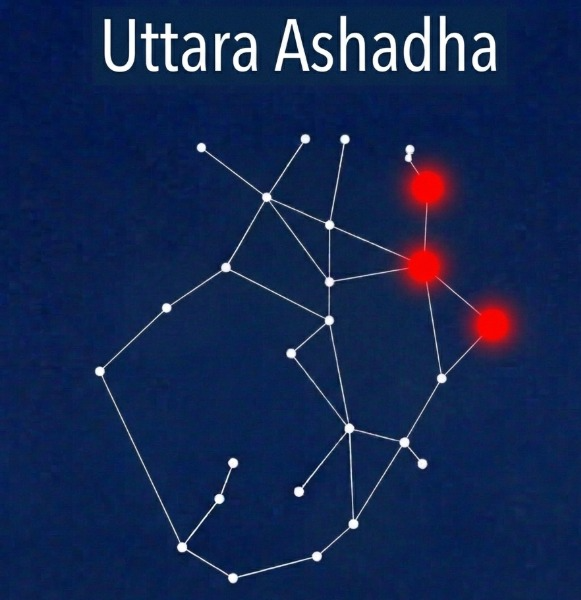
Uttara Ashadha derives its name from Uttara (latter) and Ashadha (invincible or unconquered), meaning "the latter invincible one" or "final, lasting victory." It is the twenty-first Nakshatra in the 27-Nakshatra sequence and bridges the signs of Sagittarius and Capricorn, embodying unwavering integrity, enduring foundations, universal Dharma, and permanent achievement.
The elephant's tusk or the planks of a cot symbolise unshakeable strength, royal stability, firm support, and lasting prosperity. Consequently, Uttara Ashadha is traditionally associated with permanent structures, long-term real estate investments, righteous authority, and enduring domestic harmony.
Nakshatra | |
Nakshatra (Constellation) | Uttara Ashadha |
Nakshatra Grah (Planet) | Surya (Sun) |
Symbol | Elephant's Tusk / Planks of a Cot |
No | |
No | |
Nadi | Antya |
Yoni | Nakula (Mongoose) |
Gana | Manushya |
Aaradhya-Vriksh | Kathal / Panasa (Jackfruit Tree / Artocarpus heterophyllus) |
Daan | Mahishi |
Devta | Vishvadevas (The Ten Universal Gods of Dharma & Virtue) |
Urdhvamukha Nakshatra (Upward-Facing) | |
Manda Lochan (Dim-Eyed Nakshatra) | |
Vayu (Air) | |
Dhruva / Sthira (Fixed & Permanent) | |
Core traits | Principled, disciplined, enduring, ambitious, responsible, dignified, and focused on lasting, ethical success |
Nakshatra Rashi | |
Rashi | Sagittarius (1st Pada) & Capricorn (2nd, 3rd & 4th Padas) |
Degree | 26°40′ Sagittarius – 10°00′ Capricorn |
Rashi Grah (Planet) | Guru (Jupiter) & Shani (Saturn) |
Rashi Varna | Kshatriya (1st Pada) & Vaishya (2nd–4th Padas) |
Rashi Vashya | Chatushpad (1st–2nd Padas) & Jalchar (3rd–4th Padas) |
Rashi Tatva | Agni (Fire) & Prithvi (Earth) |
Nakshatra Padas | ||||
Details | First Pada | Second Pada | Third Pada | Fourth Pada |
Pada Rashi | Dhanu (Sagittarius) | Makar (Capricorn) | Kumbh (Aquarius) | Meen (Pisces) |
Degrees | 26°40′ – 30°00′ Sagittarius | 00°00′ – 03°20′ Capricorn | 03°20′ – 06°40′ Capricorn | 06°40′ – 10°00′ Capricorn |
Pada Planet | Guru (Jupiter) | Shani (Saturn) | Shani (Saturn) | Guru (Jupiter) |
Letter (English) | Bhe | Bho | Ja | Ji |
Letter (Hindi) | भे | भो | जा | जी |
Traits | Noble, ethical, idealistic, and leadership-oriented | Practical, disciplined, structured, and materially grounded | Strategic, persistent, community-focused, and organized | Compassionate, wise, intuitive, and spiritually balanced |
Property and Vastu Suitability under Uttara Ashadha Nakshatra
Residential & Commercial Purchase (Highly Favorable): Classified as a Dhruva (fixed/permanent) nakshatra governed by the Vishvadevas and the Sun, Uttara Ashadha is one of the finest stars in Vastu for purchasing permanent homes, plots, and commercial buildings meant to appreciate steadily over generations.
Construction & Bhoomi Pujan (Highly Favorable): Supported by Urdhwamukh (upward-facing) orientation and Capricorn's earthy structural discipline, it is ideal for laying enduring foundations and erecting multi-story structures.
Residential & Commercial Griha Pravesh (Highly Favorable): Infuses a new property with dignity, moral harmony, protection, and steady, long-term prosperity for its occupants.
Government, Institutional & Corporate Headquarters (Highly Favorable): Ruled by the Sun and Saturn (Capricorn), it is exceptionally auspicious for establishing administrative buildings, corporate offices, and public institutions.
Demolition & Short-Term Ventures (Not Recommended): Because its Dhruva (fixed) energy anchors permanence and lasting victory, Uttara Ashadha is avoided when tearing down buildings or setting up temporary arrangements.
Uttara Ashadha Nakshatra is one of the gold-standard stars in Vastu for laying unshakeable foundations, acquiring permanent real estate, and anchoring enduring prosperity and dignity within a space.