Uttara-Bhadrapada Nakshatra
उत्तराभाद्रपद नक्षत्र
Uttara Bhadrapada is the twenty-sixth Nakshatra in Vedic astrology, symbolized by the back legs of a cot and ruled by Saturn and Ahir Budhnya. Discover its core astrological features, symbol, four padas, and practical suitability for permanent residences, Griha Pravesh, and Vastu planning.
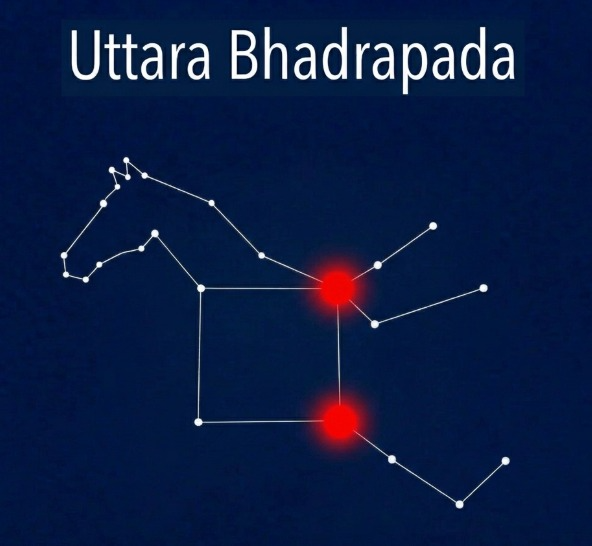
Uttara Bhadrapada derives its name from Uttara (latter) and Bhadrapada (blessed feet or auspicious step), meaning "the latter blessed feet." It is the twenty-sixth Nakshatra in the 27-Nakshatra sequence and lies entirely within the watery, spiritual sign of Pisces, embodying deep stability, enduring wisdom, cosmic nourishment, and peaceful consolidation.
The back legs of a cot, twins, or a serpent in the deep water symbolise firm structural support, spiritual depth, hidden wealth, and lasting tranquility. Consequently, Uttara Bhadrapada is traditionally associated with permanent foundations, serene residences, water abundance, and long-term prosperity.
Nakshatra | |
Nakshatra (Constellation) | Uttara Bhadrapada |
Nakshatra Grah (Planet) | Shani (Saturn) |
Symbol | Back Legs of a Cot / Twins / Serpent in Deep Water |
Yes (All 4 Padas) | |
No | |
Nadi | Madhya |
Yoni | Gau (Cow) |
Gana | Manushya |
Aaradhya-Vriksh | Neem (Azadirachta indica) |
Daan | Bakri |
Devta | Ahir Budhnya (Serpent of the Deep Cosmic Waters) |
Urdhvamukha Nakshatra (Upward-Facing) | |
Sulochana (Clear-Eyed Nakshatra) | |
Akasha (Ether / Space) | |
Dhruva / Sthira (Fixed & Permanent) | |
Core traits | Calm, wise, disciplined, compassionate, resilient, grounded, and focused on lasting peace and stability |
Nakshatra Rashi | |
Rashi | Pisces |
Degree | 03°20′ – 16°40′ in Pisces |
Rashi Grah (Planet) | Guru (Jupiter) |
Rashi Varna | Brahmin |
Rashi Vashya | Jalchar (Water-dwelling) |
Rashi Tatva | Jala (Water) |
Nakshatra Padas | ||||
Details | First Pada | Second Pada | Third Pada | Fourth Pada |
Pada Rashi | Simha (Leo) | Kanya (Virgo) | Tula (Libra) | Vrishchik (Scorpio) |
Degrees | 03°20′ – 06°40′ | 06°40′ – 10°00′ | 10°00′ – 13°20′ | 13°20′ – 16°40′ |
Pada Planet | Surya (Sun) | Budh (Mercury) | Shukra (Venus) | Mangal (Mars) |
Letter (English) | Du | Tha | Jha | Tra / Nya |
Letter (Hindi) | दू | थ / ठ | झ | ञ / त्र |
Traits | Dignified, principled, generous, and quietly authoritative | Practical, analytical, organized, and service-oriented | Harmonious, artistic, peaceful, and spiritually refined | Deep, intuitive, resilient, and transformative |
Property and Vastu Suitability under Uttara Bhadrapada Nakshatra
Residential Purchase & Permanent Foundations (Highly Favorable): Classified as a Dhruva (fixed/permanent) nakshatra ruled by Saturn (longevity) and Jupiter (Pisces), Uttara Bhadrapada is one of the finest stars in Vastu for acquiring lifelong family homes, peaceful retreats, and lasting real estate investments.
Construction & Bhoomi Pujan (Favorable — with Panchak Caution): Supported by Urdhwamukh (upward-facing) orientation and Dhruva stability, it favors laying solid foundations, though specific Panchak restrictions (such as avoiding roof casting/Chhat or collecting timber) must still be observed.
Residential Griha Pravesh (Favorable): Infuses a new household with serenity, spiritual protection, emotional stability, and steady, long-term prosperity.
Water Bodies, Meditation Rooms & Ashrams (Highly Favorable): Governed by Ahir Budhnya (deity of deep waters) in Pisces, it is ideal for designing water sanctuaries, North-East (Ishan) pooja rooms, yoga centers, and wellness retreats.
The Panchak Precaution & Demolition (Avoid): Because Uttara Bhadrapada falls within Panchak, roof slab casting and South-facing construction are avoided; additionally, its Dhruva (fixed) nature makes it unsuitable for demolishing buildings or tearing down structures.
Uttara Bhadrapada Nakshatra is best harnessed in Vastu for anchoring serene, permanent residences, nurturing spiritual and water-aligned spaces, and building enduring long-term stability while respecting Panchak construction guidelines.