Vishakha Nakshatra
विशाखा नक्षत्र
Vishakha is the sixteenth Nakshatra in Vedic astrology, symbolized by a decorated archway and ruled by Jupiter and Indragni. Discover its core astrological features, symbol, four padas, and practical suitability for main gates, excavation, commercial ventures, and Vastu planning.
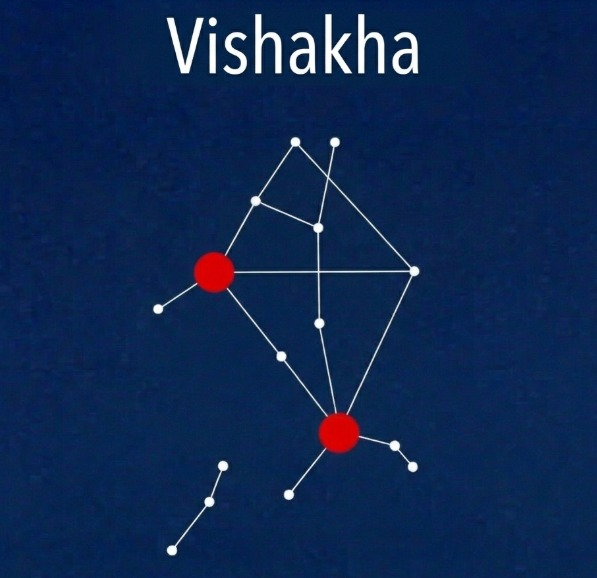
Vishakha derives its name from Vi (two/branched) and Shakha (branch), meaning "branched," "forked," or "having spreading branches." It is the sixteenth Nakshatra in the 27-Nakshatra sequence and bridges the signs of Libra and Scorpio, embodying determination, ambition, focus, and goal-oriented expansion.
The decorated archway (Torana) or potter's wheel symbolises triumph, auspicious thresholds, patient craftsmanship, and steady progress toward a clear objective. Consequently, Vishakha is traditionally associated with ceremonial gateways, purposeful construction, perseverance, and transformative achievement.
Nakshatra | |
Nakshatra (Constellation) | Vishakha |
Nakshatra Grah (Planet) | Guru (Jupiter) |
Symbol | Decorated Archway (Torana) / Potter's Wheel |
No | |
No | |
Nadi | Antya |
Yoni | Vyaghra (Tiger) |
Gana | Rakshasa |
Aaradhya-Vriksh | Vikankata / Kathal (Jackfruit or Governor's Plum) |
Daan | Yellow Clothes / Ghee / Grains / Honey |
Devta | Indragni (Joint Deities Indra & Agni — Power & Fire) |
Adhomukha Nakshatra (Downward-Facing) | |
Andha Lochan (Blind-Eyed Nakshatra) | |
Agni (Fire) | |
Mishra / Sadharana (Mixed & Balanced) | |
Core traits | Ambitious, focused, determined, enterprising, strategic, persistent, and driven to accomplish long-term goals |
Nakshatra Rashi | |
Rashi | Libra (1st, 2nd & 3rd Padas) & Scorpio (4th Pada) |
Degree | 20°00′ Libra – 03°20′ Scorpio |
Rashi Grah (Planet) | Shukra (Venus) & Mangal (Mars) |
Rashi Varna | Shudra (1st–3rd Padas) & Brahmin (4th Pada) |
Rashi Vashya | Dwipad / Manav (Libra) & Keeta (Scorpio) |
Rashi Tatva | Vayu (Air) & Jala (Water) |
Nakshatra Padas | ||||
Details | First Pada | Second Pada | Third Pada | Fourth Pada |
Pada Rashi | Mesh (Aries) | Vrishab (Taurus) | Mithun (Gemini) | Kark (Cancer) |
Degrees | 20°00′ – 23°20′ Libra | 23°20′ – 26°40′ Libra | 26°40′ – 30°00′ Libra | 00°00′ – 03°20′ Scorpio |
Pada Planet | Mangal (Mars) | Shukra Venus) | Budh (Mercury) | Chandra (Moon) |
Letter (English) | Ti | Tu | Te | To |
Letter (Hindi) | ती | तू | ते | तो |
Traits | Bold, competitive, driven, and decisive | Practical, wealth-building, grounded, and resourceful | Communicative, analytical, persuasive, and strategic | Emotional, protective, intuitive, and deeply committed |
Property and Vastu Suitability under Vishakha Nakshatra
Main Entrance, Gates & Archways (Highly Favorable): Symbolized directly by the Torana (ceremonial archway), Vishakha is uniquely auspicious in Vastu for installing main entrance doors, boundary gates, and decorative entrance arches.
Underground Excavation & Foundations (Favorable): Supported by its Adhomukh (downward-facing) orientation, it is well-suited for digging foundations, basements, wells, and underground utility trenches.
Commercial, Industrial & Institutional Projects (Favorable): Governed by Indragni (authority and fire) and Jupiter, it supports launching ambitious commercial complexes, factories, and goal-driven enterprises.
Land Clearing & Boundary Demarcation (Favorable): Its Mishra (sharp-soft) nature aids in clearing plots, resolving boundary lines, and preparing sites for phased development.
Residential Griha Pravesh & Peace-Focused Purchases (Generally Avoided): Because Vishakha carries Rakshasa Gana and Mishra (mixed/intense) energy, traditional Vastu Muhurta avoids it for calm domestic Griha Pravesh ceremonies, as it can foster competitiveness or restlessness inside a family home.
Vishakha Nakshatra is best harnessed in Vastu for establishing auspicious entrance thresholds, executing deep foundation work, and driving ambitious commercial developments rather than anchoring tranquil domestic stillness.