Dhanishtha Nakshatra
धनिष्ठा नक्षत्र
Dhanishta is the twenty-third Nakshatra in Vedic astrology, symbolized by the musical drum and ruled by Mars and the Ashta Vasus. Discover its core astrological features, symbol, four padas, and practical suitability for real estate investments, elemental Vastu, and Panchak precautions.
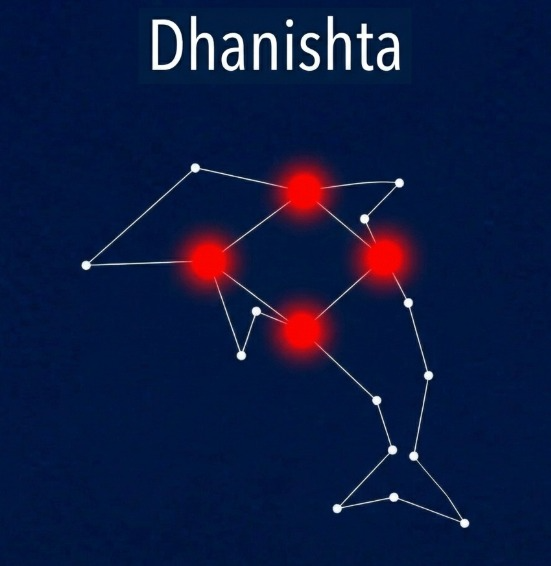
Dhanishta derives its name from Dhana (wealth) or Dhanishta, meaning "the wealthiest," "most prosperous," or "swift." It is the twenty-third Nakshatra in the 27-Nakshatra sequence and bridges the signs of Capricorn and Aquarius, embodying abundance, rhythmic harmony, resourcefulness, and dynamic prosperity.
The musical drum (Damaru or Mridanga) or flute symbolises cosmic rhythm, resonance, vibration, and the alignment of space with universal harmony. Consequently, Dhanishta is traditionally associated with acoustic balance, material prosperity, property accumulation, and coordinated group endeavors.
Nakshatra | |
Nakshatra (Constellation) | Dhanishta |
Nakshatra Grah (Planet) | Mangal (Mars) |
Symbol | Musical Drum (Damaru / Mridanga) / Flute |
Yes (Starts in 3rd Pada at 00°00′ Aquarius) | |
No | |
Nadi | Madhya |
Yoni | Simha (Lion) |
Gana | Rakshasa |
Aaradhya-Vriksh | Shami (Prosopis cineraria) |
Daan | Gold |
Devta | Ashta Vasus (The Eight Elemental Deities of Wealth & Nature) |
Urdhvamukha Nakshatra (Upward-Facing) | |
Andha Lochan (Blind-Eyed Nakshatra) | |
Akasha (Ether / Space) | |
Chara / Chala (Movable & Dynamic) | |
Core traits | Ambitious, resourceful, energetic, rhythmic, enterprising, charitable, and driven to build lasting wealth and harmony |
Nakshatra Rashi | |
Rashi | Capricorn (1st & 2nd Padas) & Aquarius (3rd & 4th Padas) |
Degree | 23°20′ Capricorn – 06°40′ Aquarius |
Rashi Grah (Planet) | Shani (Saturn) |
Rashi Varna | Vaishya (1st–2nd Padas) & Shudra (3rd–4th Padas) |
Rashi Vashya | Jalchar (Capricorn) & Dwipad / Manav (Aquarius) |
Rashi Tatva | Prithvi (Earth) & Vayu (Air) |
Nakshatra Padas | ||||
Details | First Pada | Second Pada | Third Pada | Fourth Pada |
Pada Rashi | Simha (Leo) | Kanya (Virgo) | Tula (Libra) | Vrishchik (Scorpio) |
Degrees | 23°20′ – 26°40′ Capricorn | 26°40′ – 30°00′ Capricorn | 00°00′ – 03°20′ Aquarius | 03°20′ – 06°40′ Aquarius |
Pada Planet | Surya (Sun) | Budh (Mercury) | Shukra (Venus) | Mangal (Mars) |
Letter (English) | Ga | Gi | Gu | Ge |
Letter (Hindi) | गा | गी | गू | गे |
Traits | Bold, dignified, ambitious, and authority-driven | Practical, analytical, organized, and financially prudent | Artistic, harmonious, refined, and socially balanced | Intense, strategic, enterprising, and deeply resilient |
Property and Vastu Suitability under Dhanishta Nakshatra
Real Estate Investment & Commercial Expansion (Highly Favorable): Governed by Mars (land/Bhumi Karaka) and the Ashta Vasus (deities of material abundance), Dhanishta is auspicious for acquiring income-generating properties, commercial complexes, and real estate investments (best utilized in the 1st and 2nd Padas before Panchak begins).
Construction & Upward Elevation (Favorable): Supported by Urdhwamukh (upward-facing) orientation and Akasha (Ether/Space) Tatva, it supports vertical construction, adding upper floors, and optimizing open central spaces (Brahmasthan).
Acoustics, Music Rooms & Elemental Vastu Balancing (Highly Favorable): Symbolized by the drum and ruled by the eight elemental Vasus (Earth, Water, Fire, Air, Space, Sun, Moon, Stars), it is ideal for setting up music studios, auditoriums, and harmonizing the five elements (Pancha Tatva) in a building.
The Panchak Precaution (3rd & 4th Padas): Because Panchak begins at the midpoint of Dhanishta (00°00′ Aquarius — 3rd Pada), traditional Vastu Muhurta avoids initiating roof casting (Chhat), wood collection, or South-facing construction during its latter half.
Residential Griha Pravesh (Moderately Favorable / Conditional): While its wealth-bringing energy is positive, Rakshasa Gana, Chara (movable) nature, and Panchak overlap make astrologers cautious—if used for Griha Pravesh, it is strictly scheduled in the 1st or 2nd Pada (Capricorn portion).
Dhanishta Nakshatra is best harnessed in Vastu for real estate wealth creation, elemental (Pancha Tatva) harmonization, and upward structural growth—provided the Panchak boundary in its latter half is carefully respected.